Friday, 23 February 2018

Arizona pricklies

Sitting outside drawing plants is very pleasant when it isn't too cold, wet, hot, windy, dark, buggy, noisy or otherwise uncomfortable.  Which it wasn't in the Arizona desert in the winter.

This is a saguaro, the unmistakeable icon of the Sonoran desert of southern Arizona and northern Mexico.  I think they would be perfect for a beginner's life drawing course.

Cholla species come in a variety of forms, each one nastier than the next, at least if you walk into one.  The staghorn species is a pleasant purplish colour, with interesting fruits that stay around for a long time.  But beware the teddy bear - it's the nastiest of all.

Barrel cactuses have the curious habit of leaning towards the south - convenient if you happen to be lost in the desert when it is too cloudy to see the sun and too foggy to see any mountains.  Which is fairly unlikely.  Apparently the number one natural cause of death of barrel cactuses is falling over.  The evolutionary advantage of this is a bit obscure.

And finally, one wannabe cactus, the ocotillo.  This shrub mostly stands around looking like 10-foot-tall dead sticks, until there's enough rain for it to produce little leaves for a few weeks.  It's thorns are a little less deadly than cactuses', but still not the sort of thing to bush-whack through.  It was the only thing flowering in the desert in February, but it was doing so in a spectacular way.


Wednesday, 21 February 2018

Arizona - quick scenes

I got to spend a 5-day weekend - my company is thinking of making those standard policy - in the Tucson Arizona area as an "accompanying person".  The winter weather is perfect for us northeners, for hiking in the desert, bird-watching and desert botanizing.  With, of course, a few quick sketches along the way.

First, a brief stopover in the Los Angeles airport on the way down: 10 minutes to try to catch the spectacularly southern-California colours at dusk.

Finger Rock Canyon was just down the road from where we stayed on the outskirts of Tucson.  It's one of those devious walks that makes you want to check out what is just over the next bump, or just around the next point, until you find you've climbed the entire mountain and are left wondering if your legs will survive the trip down.  The rock strata are all tilted appealingly, and that day the clouds were marching along in parallel.

Kartchner Cavern is about an hour out of Tucson, and is one of the wonders of Arizona. (It would be the wonder, if it wasn't for that little canyon thingee in the north of the state).  You clearly enter a different planet, if not an entirely different universe, when the guides escort you underground through the multiple entry doors.  The level of concern for protecting the cave environment is wonderful, and that includes not allowing any objects into the cave - no cameras, phones or even sketchbooks.  If I had had a sketchbook, I would have been far too awestruck to use it anyway.  But I did get a quick sketch of the surrounding countryside while waiting for our tour.

I hiked in Sabino Canyon park on US President's Day, when entry was free and there were at least a thousand people in the park.  But with recent rains, Sabino Creek was high enough that it took some agile rock-hopping to cross, and I ended up seeing all of two other people on the far side of the creek.  It was a blustery day, with clouds flying by in the wind, and my paints almost flying into the creek at one point.

The city itself would be great for sketching if you lived there and found all the little details of urban life in a gritty desert environment.  Or if you really liked suburbs and shopping malls.  But it was challenging to find anything definitive to capture the place in my quick fly-by tour of the downtown area.  I settled on a cheerful and fairly humble "mansion" in the small area of the El Presidio neighbourhood that retains some of the older buildings in this not-very-old city.  The Cheyney mansion from 1905 is not quite as wobbly as I drew it - I blame a strong and surprisingly cold wind, and the incessant roar of fighter planes flying over the whole time for adding a bit of hurried "looseness".


Thursday, 11 January 2018

I'm on Instagram

I have been assimilated - I'm on Instagram.  It's easier to post miscellaneous drawings there.  And I know that someone other than Russian hackers and Chinese search engines are seeing my drawings.  But I'll continue to post here, especially for things that require more than a square picture taken with a poor camera phone.  Instagrammers can find me @dave.huggard.drawing.  For others, try www.instagram.com/dave.huggard.drawing/


Monday, 1 January 2018

A Dozen Drawing-A-Day's

I started a 30-day drawing-a-day plan two weeks ago, figuring that I could get some drawing momentum built up over the holidays and continue it into the New Year.  So far, so good.  Doing a drawing (or more) a day lets me experiment more.  If it turns out horribly, as some do, well, there's always tomorrow.  These are ones that I like - a mix of outdoors (with a couple of ice-colour paintings included) and things I found to draw indoors on the worst days, or when it was 10p.m. and I hadn't done the day's drawing yet.

Get it done before the sun is even up:

Christmas ornaments are perfect models:


Five-minute portraits on the seabus.  All praise to beards - you get a lot of chances to get the chin right!

The ski-and-sketches.  Some nice ice crystal development in a couple of these.  The background trees in the last one were painted using the big wet snowflakes that were rapidly covering the page, instead of water.


Details of warm interiors, as heavy sleet or dusk fell outside.


A more abstracted view of the first morning sunbeams in the dawn forest.

And finally this fellow - a snow-covered sapling, or the ghost of one of the early Hollyburn pioneers?


Sunday, 10 December 2017

Ice-colour painting - endangered?

The challenges of using watercolours outside when it is below freezing are well rewarded by, umm... trying to capture details with frozen-solid brushes? blotchy skies? frostbitten fingers? Well, maybe a unique style, a sharper appreciation for working quickly, and definitely a memorable experience.  This is a good example from early November, when it was about -6C on Hollyburn peak.  You can see some nice crystalization in the sky and mountains.
But my recent attempts have failed - it just hasn't been cold enough.  This one from the Hollyburn cross-country area as the clouds rolled in was close, just below 0C, but not quite enough to freeze the paint.

Even Edmonton, on the last day of November - this should be the world centre for ice-colour painting - came in well above freezing as I drew the river from a pedestrian bridge.

And back on Hollyburn Peak, mid-December now, it was a sunny +9C with a warm breeze, in a strong inversion that was blanketing Vancouver below in fog.  It was so warm that I skied up the rapidly melting (but still deep) snow in a short-sleeved shirt, and people on the peak were dancing around in their underwear.  (There are still a few eccentric and exuberant people left in this age of internet shaming).  I am wondering if the days of ice-colour painting are numbered...


Monday, 4 December 2017

Dr Sketchy has a birthday

It was party night at Dr Sketchy's on Sunday (as if it isn't always party night at Dr Sketchy's), celebrating a ninth birthday, all hosted by the beloved Shari Contrary.  The model was the same one who started it all - before my time - the lovely and talented Melody Mangler.  Food, beer, music, lively company, Ms Mangler, and lots of drawing - it's hard to think what else you could want for a birthday.  I'm just a bit leery about what will happen when Dr S  hits those awkward teenage years...


Sunday, 19 November 2017

Polygon Gallery

The Polygon Gallery opened this weekend on the waterfront in North Vancouver.  It is a major upgrade on the old Presentation House gallery, retaining the focus on photography.  The building is interesting architecturally, with a glass-walled lower floor and the gallery upstairs, where a series of triangular roofs give a visual nod to the North Shore mountains while letting in natural light from the north.  A second-floor atrium and balcony give views of Lonsdale Quay, the harbour and the city of Vancouver.  Most importantly, the building provides a beautiful space for the art, without shouting "Look at me, I was designed by an architect!"  In a place where we often sit around lamenting better things that have been replaced by condominiums, I think the gallery will be a very positive addition to the city.  Here is my quick "wet-on-wet-in-wet" impression (it was pouring rain).

The opening exhibition focuses on North Vancouver, with an appealing mix of photographs - some historical, some from the contemporary photographers that Vancouver is most famous for in the international art world - and sculptures and weaving, much of it from local First Nations artists.  A huge light-box photo by Rodney Graham is one of my favourite local art works.  It's visually very attractive, and has layer-upon-layer of interpretations (at least, I think so - I don't know what the "official" story is!)

The sculptures are a happy addition for sketchers, more fun to draw than trying to make a picture of a picture.  I was joined by a couple of knee-high future artists drawing Gabrielle L'Hirondelle Hill's quirky piece made from parts found in the historical shipyards nearby.  And I appreciated Cameron Kerr's large yellow-cedar sculpture representing a central element of North Vancouver culture - a bridge on the highway.


Sunday, 5 November 2017

Corsica V: Mountains, and a bonus

Our last day in Corsica was spent crossing the island, winding up one side of the central mountains, and winding down the other.  And regretting not having far more time there, for the whole country but specifically for the several beautiful gorges with long hiking trails.  The trails were fairly old - some of the recent upgrades were done by the Romans.  This bridge near Ota wasn't quite that old, but was an amazing piece of stone work, a slender arch less that two feet thick spanning a large river, and strong enough to support countless mule trains over the centuries.
The higher mountains had forests of pines, other conifers and some deciduous trees showing fall colours, with soaring granite cliffs behind them.  They looked like Yosemite or other parts of the US southwest.  Right near treeline were some huge, weather-beaten Corsican black pines that I had to add to my sketch collection of Really Big Trees of the World.
Overnight at an olive farm surrounded by grapefruit orchards near Bastia, then back home.  I didn't get any drawing done while negotiating the metropolis of Charles de Gaulle airport in Paris, but I did get this one quick sketch in of our IcelandAir landing in Reykjavik - huge storm waves on the North Atlantic, the dark coastal rocks and green tundra.  About as far as you could get from the sunny turquoise Mediterranean in a few hours' flight...


Friday, 3 November 2017

Corsica IV: Piana and the Calanches

Back to the coast, we stayed a couple nights in an elegant hotel from the early twentieth century.  Les Roches Rouges in Piana was the place to be in the 1920's, but was abandoned for several decades.  It is now being resurrected, and has an appealing decayed art deco Jazz Age vibe - it is a pretty fine place to be in this century too.
Like most places in coastal Corsica, there's a beach.  No aggressive cows here, but there was a large herd of goats to navigate by on the winding road from Piana.  And - unusual in our experience on Corsica - there were other people on the beach.  Nine of them, to be precise (I counted).  One of the 16th-century anti-pirate guard towers dominates a rock outcrop in the background.
A main attraction in the area is the Calanches, a range of jagged red mountains eroded into fantastical shapes.  We climbed way up into the alpine, seeing only one other person - a Corsican hunter who pointed out the best trails, speaking in Corsu, which is a surprisingly understandable medieval form of Italian with some French thrown in.  We did a bit of scrambling up some small peaks, where the eroded stone made ridiculously easy hand- and foot-holds.  I sat on top of one outcrop and drew the rock formations, one of which looked either like a French aristocrat or mating cows, depending on your point-of-view.

Wednesday, 1 November 2017

Corsica III: Hill towns

Along with the coastal fishing villages, Corsica is also covered in a scattering of hill towns.  A few hundred people cluster together in a dense ancient settlement, largely surrounded by forest.  In Pigna, the thing to be is a luthier, although potters, music-box-makers and other artists and craftspeople are popular choices too.  There is also at least one good cook, as our al fresco lunch featuring wild mushrooms showed.
The lower hillslopes also have vineyards, including about 20 small family wineries in the Patrimonio region.  We did a quick tour one afternoon, then had a picnic of wine, cheese and bread on the pier in St. Florent.

We spent one night in one of the higher towns, Speluncato, which wraps itself around a rocky outcrop, surrounded by bigger mountains.  It was a cool autumn late afternoon when we got up the long, winding and narrow road to the town, with the clouds hanging on the nearby peaks.  Kids were playing "spy" in the piazza, complete with walkie-talkies, and were delighted that a foreigner showed up and engaged in clearly suspicious behaviour involving a notebook and something cleverly designed to look like a watercolour kit and brushes.

The next morning was brilliantly sunny, perfect for hanging out in all the little nooks and crannies in the centuries-old laneways.  It's a pretty quiet place - passersby were two cats, and one old dog who also thought I was suspicious, until he decided that he was more sleepy than suspicious and had a nap at my feet.


Monday, 30 October 2017

Corsica II: Cinturi and St Florent

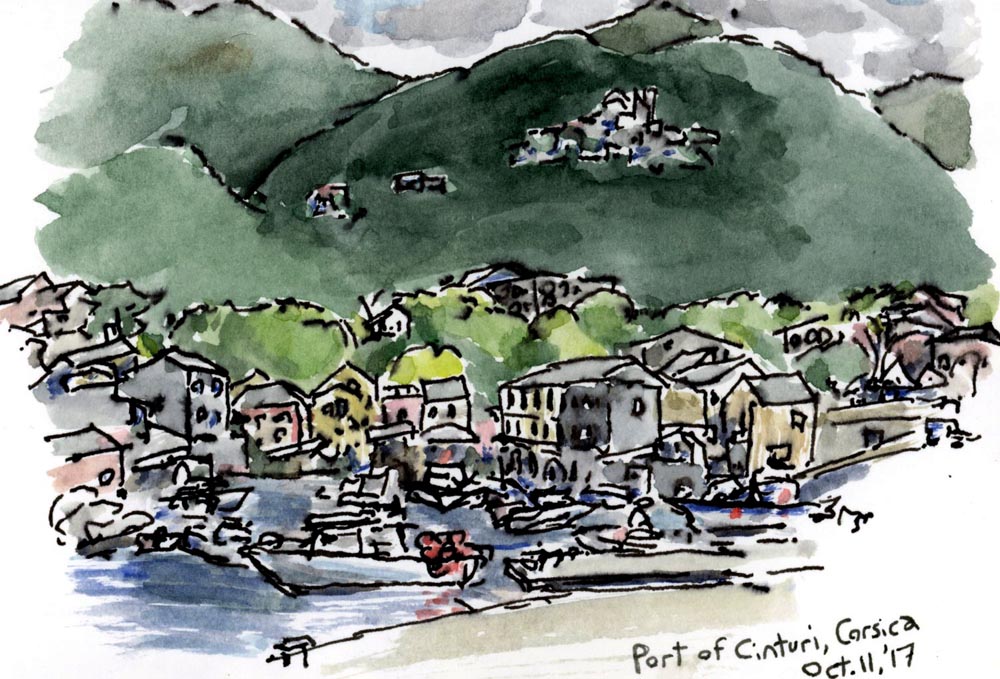
The drive across Cap Corse and down the west coast is slow - not just because of the narrow winding roads, but because you want to stop at every picturesque village and beautiful undeveloped hillside or coast.  Which is to say, everywhere.  The fishing port of Cinturi was one stop on the way, where we lingered long enough for a quick sketch of the boats in the harbour, and the actual Cinturi, a hillside village, way above it.  This is a common set-up - the main village far above the port.  We wondered why - pirates?
St Florent is a bigger town, popular with the yachting set (one harbourside restaurant cleverly offered delivery to your boat), but very quiet in the still-perfect days of early autumn.  The main event in town is the 5 o'clock gathering of older men to play bocce/petanque/boules in the tree-lined piazza dedicated to the purpose.  The same thing happens at the same time in every settlement with a male population of 4 or more throughout Corsica.
The area also has large nature reserves and beautiful swimming beaches.  I tried a quick paint-only sketch of the outrageous colours in one bay - not very successful, and not helped much by the addition of some water-soluble blue ink.  I blame a long hike in the sun, plus lack of practice.  There must be some kind of Canada Council grant I could get to work on my sketching of remote Mediterranean beaches...


Sunday, 29 October 2017

Corsica I: Bastia and Cap Corse

For people used to BC Ferries, the ferry to Corsica was ... different.  Think restaurants with waiters, lounges with armchairs and brass fittings, reclining deck chairs, a pool.  It was a re-purposed cruise ship, so now I can check "Go on a cruise" off my bucket list (where it occupied one of the bottom-most positions).  We cruised past Capraia Isola, Island of Goatherdesses, on the way - one of several sparsely inhabited isolated Mediterranean Islands that very few people have ever heard of.
Bastia is a main town on Corsica, but still small.  We walked across half of it and back in the two and a half hours that the rental car agency was closed for lunch.  We toured the old town and had lunch in the plaza of the citadel, where this old palace had two clocks - an original sundial that was perfectly accurate (except not programmed to change to daylight savings time), and a more modern mechanical clock that was broken.
When we got the car - a fearsome Citroen Berlingo - we made our way towards the north end of Cap Corse, and were quickly winding along mostly undeveloped coast, with little villages above on the treed slopes, and almost no one on the roads.  And that's the way it would stay for our entire trip around the north half of the island - relentlessly curvy roads, large areas of wild maquis scrubland, forest and alpine, scattered ancient villages, and more pigs and goats than cars on the roads.  We hiked for over three hours around a nature reserve and several beaches the next morning, following the Sentier des Douaniers on the north end of the island, and saw precisely 0 other people.  This guard tower is one of a series that ring the island.  They were built to warn of pirate attacks, apparently the bane of Corsicans for several centuries.  The watchmen lit a fire on the tower when pirates sailed over the horizon, and the signal was taken up by adjacent towers, spreading the message around the whole island in a couple of hours.  It was the Twitter of its time.